Architecture Students Look to the Ordinary in Copenhagen
POSTED ON: April 1, 2026
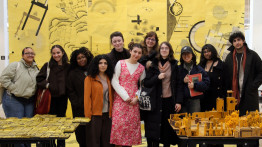
Cooper students with Mersiha Veledar AR'03, acting associate dean of The Irwin S. Chanin School of Architecture. Photo by Anne Romme.
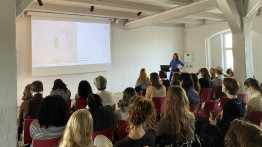
Anne Romme AR’05 delivering a lecture. Photo by Mersiha Veledar.

Façade reliefs. Photo by András Weiszkopf.
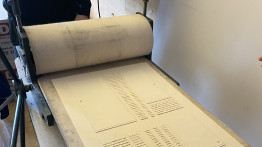
Façade relief using paper press.
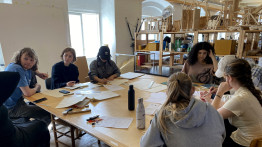
Architecture students from The Cooper Union working with students from the Royal Danish Academy. Photo by Mersiha Veledar.
Over spring break, a group of students from The Irwin S. Chanin School of Architecture and the Finder Sted/Taking Place program at the Royal Danish Academy came together in Copenhagen for a weeklong workshop titled Variations in the Ordinary. Running from March 16 to 20, 2026, the workshop took place in Copenhagen’s NV (Northwest) district, an area rich in significance for studying the trajectories of twentieth-century urban development.
Focusing on the material and spatial logics of everyday architectural elements through the lens of affordable “welfare state” architecture, the workshop explored how spatial variations emerge through repetition—in brickwork, proportion, and the layered fabric of key residential and cultural neighborhoods. Through site visits, analytical drawings, lectures, and hands-on artistic methods, students from both institutions investigated how subtle variations in materials, construction techniques, and program shape architectural character, longevity, and everyday use over time.
“The workshop was an unforgettable experience for our students, and one we hope to continue cultivating in the years ahead,” said Acting Associate Dean Mersiha Veledar AR’03.
Variations in the Ordinary was organized and led by Veledar along with Cooper alumna Anne Romme AR’05, previous program leader of Finder Sted/Taking Place and newly appointed Head of Institute at the Oslo School of Architecture and Design, as well as Emil Hvelplund, co-founder of the Royal Danish Academy's Paraply summer school. Royal Danish Academy faculty members Ide Flarup, associate professor, and Arne Høi, Head of Institute, also welcomed the participants, while András Weiszkopf, from Budapest University of Technology and Economics, joined the workshop as a guest professor.
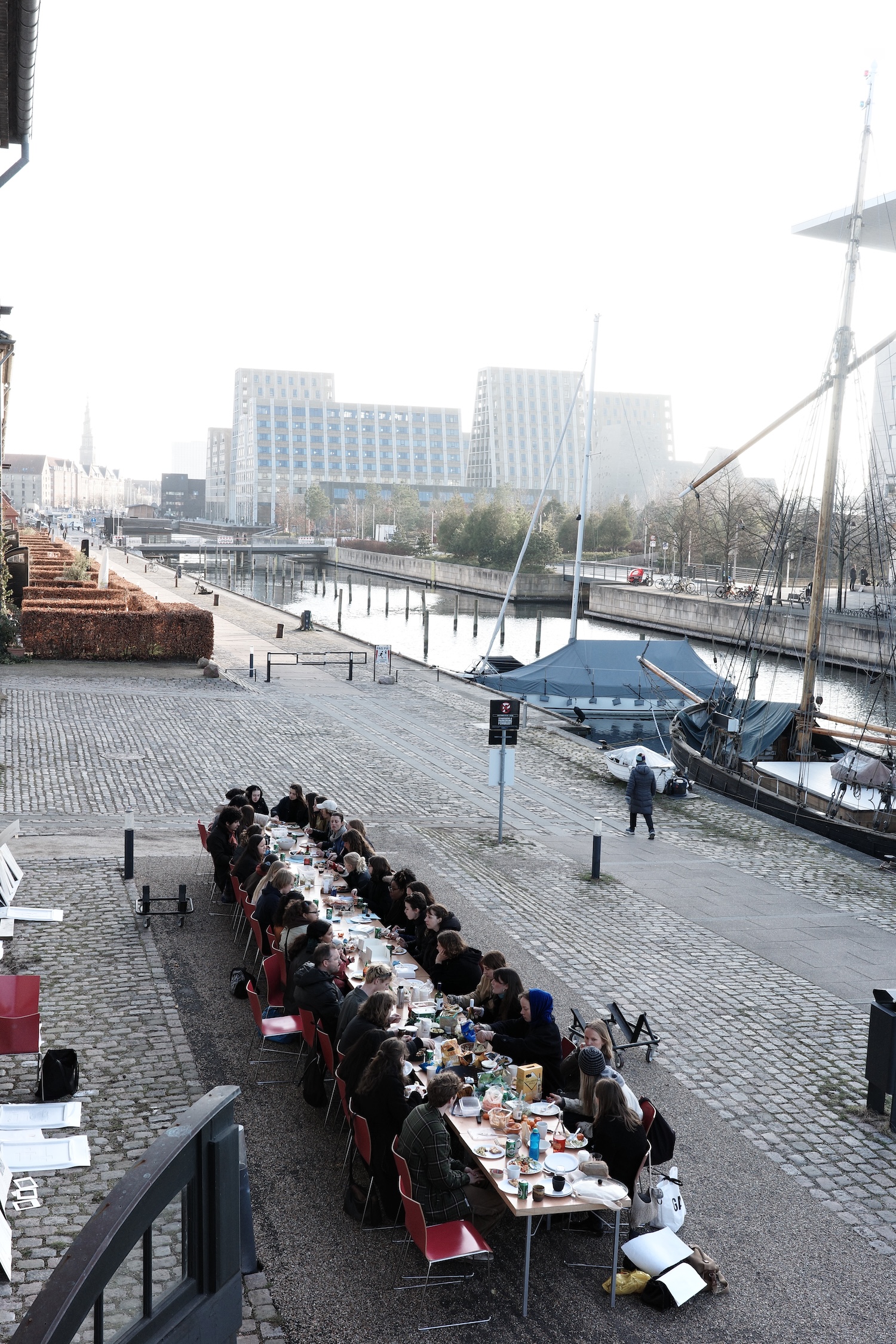
Participants from The Cooper Union included one M.S.Arch. graduate student, Hanping Wang, and ten B.Arch. students: fifth-years Aaliyah Torres and Shannagh Crowe; fourth-years Amira Walcott, Angelis Heredia, Belinda Lin, and Katherine Sazhin; and third-years Saam Shojaie, Helena Uceda, Leah Varghese, and Zekaiya Whittington.
“Exploring this beautiful city alongside my classmates was an incredible experience,” said Helena Uceda. “We collaborated closely with Royal Danish students, gaining insight into their studio culture and ways of working while also seeing the city’s architecture through their perspective.”
Belinda Lin added: “The opportunity to experience somewhere new is always exciting, and to be introduced to the city by people who live and study there is a different kind of special.”
The collaboration forms part of an ongoing exchange. In 2019, Cooper architecture faculty members visited the Royal Danish Academy, and in 2022, the institutions collaborated on the exhibition Practices of Risk, Control and Productive Failure at the Brønshøj Water Tower in Copenhagen, which included work by professors Michael Young, Mersiha Veledar, and Nader Tehrani, among others. Later that same year, an exhibition of Royal Danish Academy faculty work, At the Intersection of Ideas and Material Conditions, was presented at The Cooper Union. These activities were supported by the Obel Foundation.
Through initiatives such as the workshop, faculty from the two institutions hope to continue developing a shared platform for architectural education that is grounded in both material practice and critical reflection on architecture’s role in creating a greater social good.