Archlog
Behnaz Assadi Named the Inaugural John Q. Hejduk Endowment Awardee
POSTED ON: September 2, 2026
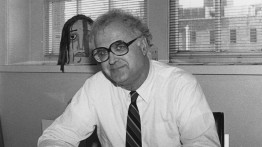
John Hejduk in the dean’s office of the School of Architecture. Photo by José Pelaez, 1985.
The Irwin S. Chanin School of Architecture is pleased to announce Professor Behnaz Assadi as the inaugural recipient of the John Q. Hejduk Endowment Award for Architectural Research. This fund establishes an annual honorarium supporting exemplary work by faculty of The Irwin S. Chanin School of Architecture for two years. It is awarded to support practice, scholarship, teaching, or research that reflects diverse voices, ethnicities, trajectories, or communities.
Founded by former dean Nader Tehrani, the endowment’s focus on supporting faculty development is grounded in the legacy and generosity of the architect John Q. Hejduk (1929–2000) who provided opportunities for transformative research and intellectual growth to talented, emerging educators and practitioners throughout his twenty-five-year tenure as dean of the School of Architecture.
Reflecting on the origins of this effort, Tehrani explained: “Having known Hejduk’s impact on the architectural discipline for over forty-five years, it seemed appropriate that we celebrate his notion of the ‘social contract’—of giving back through teaching, by rewarding an exemplary pedagogue who continues his legacy in new guises and formats. It gives me great pleasure to thank everyone who contributed to this endowment, and I find Assadi’s stubborn focus on drawing as a perfect fit to extend a culture that Hejduk lovingly molded for decades at Cooper Union.”
Behnaz Assadi is founding principal and partner of the Toronto-based JA Architecture Studio. In her practice and teaching, she explores landscape architecture’s agency beyond disciplinary confines with an interest in landscape processes and how they relate to the built environment. Using multi-scalar investigations, drawing, and modeling, she integrates ecological literacy with the precision of architectural construction.
This award not only recognizes Assadi’s work, but also supports her as she carries forward a particular culture of architectural inquiry: “To be the inaugural recipient of an award bearing John Hejduk’s name is both an honor and an invitation. Cooper has a remarkable history of bringing emerging questions back to the core of the discipline, and in doing so, continually expanding the territory of architectural thought. At a moment of profound environmental change, I am especially grateful, as a landscape designer, for the opportunity to extend my own research within this tradition. I can think of few places where this work could feel more at home.”
Please join me in congratulating Behnaz on this exciting opportunity to develop her creative work. Many thanks to all who have already supported this initiative—it will significantly impact the trajectories of young architects and educators for years to come. For those who would like to support the endowment, please visit Cooper Union’s website and indicate John Q. Hejduk Endowment for Architectural Research under Gift Memo.
— Michael Young, Dean
The Irwin S. Chanin School of Architecture
Christian Nobile Dickson, 1969-2026
POSTED ON: May 1, 2026
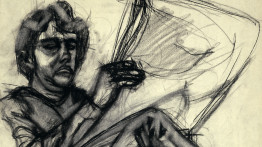
Self Portrait. Freehand Drawing, 1987-88.
Christian Nobile Dickson—Chris—passed peacefully on April 24, 2026, in Branford, Connecticut, at the age of 57, following a sudden decline in his health.
Born on March 22, 1969, in Belleville, New Jersey, Chris moved through the world with a rare combination of sensitivity, curiosity, and creative force. He was known not only for his love toward others, but for his ability to awaken that feeling in them. To know him was to feel more alive, more seen, more at ease, and more yourself.
His love of art began in early childhood. He would spend hours sketching the world around him. A turning point came when a perceptive art teacher, Doug Castellano, recognized his talent and encouraged him to pursue it more seriously. Chris entered the Art in the Park Festival in Hazlet, New Jersey, and won second place.
What began to emerge in him then was more than skill, it was a way of seeing. He was beginning to understand that the same sensitivity that allowed him to perceive people so deeply also allowed him to perceive space: to imagine how something could feel, how it could hold life within it. That early encouragement gave him permission to trust that vision; to believe that his perception, his intuition, and his creativity were not only real, but meaningful. It was this insight and confidence that led him to apply to The Cooper Union.
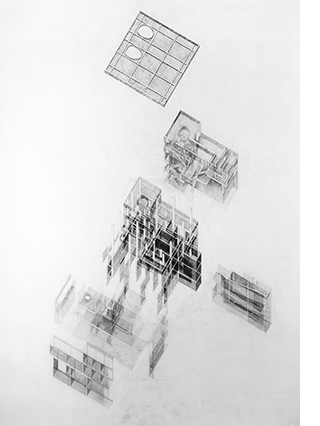
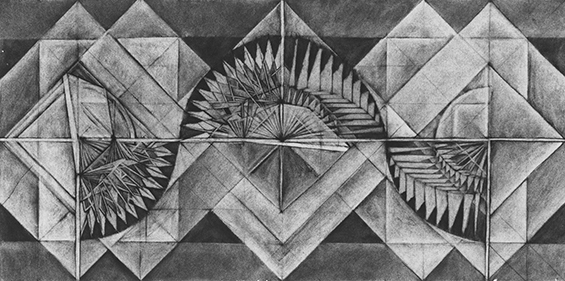
He studied architecture at The Cooper Union in New York City, where his mind and spirit found their natural expression. There, he learned to give form to his ideas through drawing and design, earning the respect of his peers and professors. In recorded critiques of his student work, architect John Hejduk spoke of Chris’s drawings in striking terms, describing them as possessing a rare clarity and insight, an attempt to grasp something fundamental, even “how God thinks.” It was a reflection of the depth, detail, and originality that would define his work.
After graduation, Chris began his professional life with a quiet confidence that would define his career. Through his work at Alex Gorlin Architects, Brian O’Keefe Architect PC, and Robert A.M. Stern Architects, LLP, he brought a steady brilliance to everything he touched. He helped shape spaces that felt both ordered and alive, contributing to projects such as the East Hampton Town Hall on Long Island, and leaving his mark on New York’s cultural landscape through the design of Bar Veloce.
In the wake of COVID in 2020, he and his wife, Mary, made a home in West Hartford, Connecticut, where he founded Christian Dickson Architecture. His work was never just about buildings, it was about people. He listened deeply, designed thoughtfully, and believed that a space should reflect, and even lift, those who inhabit it. His work was, in every sense, an extension of his way of being in the world.
In his personal life, Chris understood that connection is the purest form of love. He gave his full attention, without judgment, without hurry. He moved through museums and sculpture gardens in conversation, not just observation. He shared music, food, ideas, and laughter, always with intention, always with joy. He had a gift for presence. He could sit with you in silence over coffee, or talk for hours about what mattered most. He reminded us that life is not something to rush through, but something to inhabit.
Chris shared a profound and enduring love with his wife, Mary. Together, they built a life of creativity, partnership, and deep understanding. She was his home, his advocate, and his constant. Their bond was unmistakable and unwavering.
He is survived by his wife, Mary Badon; his parents, Terry and Barry Dickson; his sister, Anne Dickson; his brother-in-law Tony Botzas; his nieces and goddaughters, Hannah and Ellie; his mother-in-law, Boguslawa Badon; his brother and sister-in-law, Sebastian Badon and Elena Klonoski; and a wide and devoted circle of family and friends who will carry him forward in countless ways.
A Celebration of Life will be held at LiteBox Studios Collaborative Event Space (1429 Park St, Hartford, CT) on Friday, May 1 from 6:00–8:00 PM. All are welcome to come and have coffee with Chris one last time.
A Funeral Service will be held at St. James’s Episcopal Church (1018 Farmington Ave, West Hartford, CT) on Saturday, May 2 at 10:00 AM, followed by a repast. All are welcome.
Chris’s spirit continues, in the spaces he shaped, in the people he loved, and in the moments he taught us to slow down and truly see.
Remembering Fred Chomowicz
POSTED ON: April 1, 2026
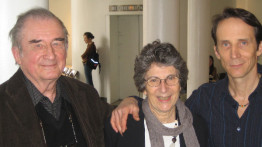
Fred Chomowicz with his wife Lucille and son David at his retirement party on April 13, 2006.
Fred Chomowicz AR'53—artist, architect, actor, and adjunct professor—passed away on March 19, 2026 at the age of 93.
A native New Yorker, Fred graduated from Brooklyn Technical High School before attending The Cooper Union School of Architecture. In his very first week of class, he helped a first-year art student, Lucille Young, figure out how to use a ruling pen. That chance encounter led to a 71-year marriage—Fred and Lucille were a true Cooper Couple. Though a city guy through and through, Fred had a love of sports and the outdoors, and some of his fondest memories of Cooper were at Green Camp.
After graduating in 1953, Fred attended the University of Cincinnati School of Architecture on a full scholarship, followed by two years of service in the U.S. Army at Fort Belvoir, Virginia.
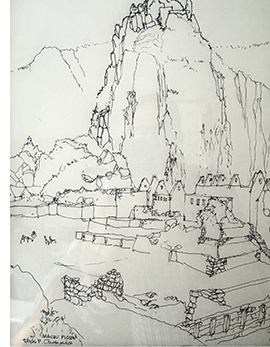
Fred and his family returned to New York, where he built much of his career at Davis, Brody, Bond Architects. Specializing in laboratory and medical buildings, he founded and led the firm's Philadelphia office for many years. In the late 1980s, he began teaching at Cooper Union, ultimately spending more than two decades here. His course on professional practice was one that, by his own admission, most students didn't pay much attention to while absorbed in their thesis work, but it was the one he heard about most often afterward. Alumni reached out to him for years, grateful for the practical foundation his course had given their careers. Upon retirement, Fred and Lucille moved to Portland, Oregon, where for more than ten years he supported Zimmer, Gunsul, Frasca Architects on projects throughout the U.S. and abroad.
Fred also discovered a passion for stage acting at Cooper Union and never let it go. Throughout his career, he joined the casts of dozens of community productions across New Jersey, delighting in offbeat characters, especially those that called for a mastery of foreign accents. He was a lifelong traveler who explored Asia and South America, though it was to Europe that he returned most often. He never tired of Paris or Venice, his two most beloved cities.
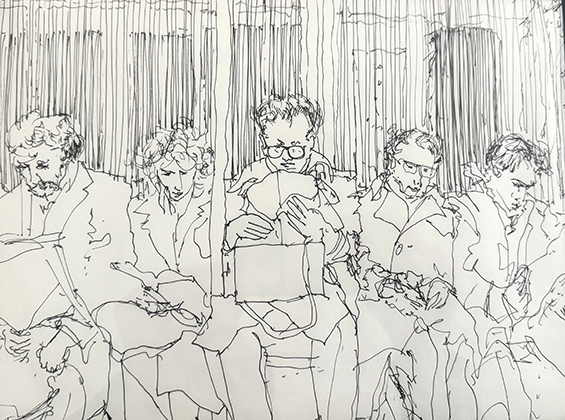
Throughout his life, Fred was a draftsman. He drew everything: cities, buildings, the textures of daily life, and most especially people. His thousands of drawings of fellow commuters stand as a remarkable portfolio of a life spent in keen observation of humanity. This was Fred's singular gift as an artist: he held up a mirror to the world so that the rest of us might better understand it—and ourselves. In his characters, his drawings, his buildings, and his teaching, Fred offered a quiet conviction that each of us has something to contribute to a deeper understanding of what it means to be human.
Fred is survived by his wife Lucille A'54, his daughter Amy, his sons David and Peter AR'89, and four grandchildren.
CCA Acquires Diana Agrest and Mario Gandelsonas' Work
POSTED ON: September 17, 2025

The Irwin S. Chanin School of Architecture is pleased to announce that the Canadian Centre for Architecture (CCA) has acquired the work of Diana Agrest and Mario Gandelsonas. This important acquisition marks their pioneering contributions to the field of architecture for over five decades. Materials transferred to the CCA in July 2025 include 80 tubes of original drawings, nearly 70 folios of sketches and project materials, 14 architectural models, and over 35 boxes of manuscripts, projects texts, photographic materials, publications, correspondence, and pedagogical documents.
Agrest and Gandelsonas are internationally recognized for their innovative approaches to architecture and urbanism, and both have left an indelible mark on the discipline through their speculative and built work, theory, publications, and pedagogy. Throughout their careers, they have challenged conventional understandings of space, place, structure, and cultural contexts, pushing the boundaries of architectural thought and practice.
Diana Agrest’s work has had a profound influence on the professional, theoretical, and academic spheres of architecture. As the Irwin S. Chanin Distinguished Professor at The Cooper Union, Agrest's critical engagement with the history and theory of architecture, particularly her explorations of modernity, urbanism, feminism, nature, representation, and film—as well as her transdiscursive approach to architecture—has inspired generations of students. Her work and her contributions to architectural discourse continue to resonate today as a touchstone in architectural scholarship.
Mario Gandelsonas, whose intellectual contributions extend across architecture and urban theory, is renowned for his groundbreaking work on urban form and the social implications of architecture. As a long-time professor at Princeton University, Gandelsonas has not only enriched architectural education but also catalyzed fresh perspectives on the role of architecture in shaping societal frameworks. His theoretical publications and architectural projects have consistently examined the intersection of the built environment with cultural and political conditions.
Together, Agrest and Gandelsonas' collaboration over the years has produced some of the most innovative and influential ideas in architecture, blending rigorous theory with creative practice. Their joint projects—most notably in the realm of urban form and discourse—have explored how architectural form interacts with social, cultural, and historical forces. Their partnership embodies a critical and interdisciplinary approach to the profession, and their work continues to inspire a new cohort of architects and urban planners.
The acquisition by the Canadian Centre for Architecture is a testament to the significance of Agrest and Gandelsonas' legacy in the ongoing evolution of architectural thought. Their archives, now housed at the CCA, will serve as a valuable resource for researchers, educators, and students alike, ensuring that their contributions to the field will continue to shape the future of architecture for many years to come.