In Memoriam: Fred Chomowicz AR'53
POSTED ON: April 15, 2026
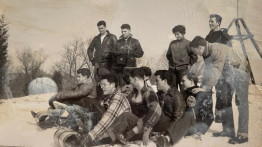
At Green Camp. Lucille Chomowicz in the back row with Fred Chomowicz to her left and illustrator Don Bolognese A’54 to her right.
A tribute by Peter Chomowicz AR’89
Fred Chomowicz AR’53—artist, architect, actor, and adjunct professor—passed away on March 19, 2026 at the age of 93.
A native New Yorker with a sharp mind who could master almost any subject, Fred skipped grades to graduate early from Brooklyn Technical High School. While working as a delivery boy for the garment manufacturer, M. Lowenstein & Sons, his boss suggested that he apply to The Cooper Union. Fred recalled him saying, “All you have to do is pass their test and you get a free education!” Free was certainly something Fred was interested in, as was a technical education. Brooklyn Tech had given him a passion for design, and for a time, Fred thought that either fashion or industrial design might be his calling, until he discovered architecture.
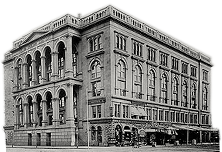
The entrance exam at Cooper was held in the Great Hall, and he recalled how it seemed equal parts psychological and artistic, with a warning that applicants should not try to figure out what the school was looking for. The artistic test consisted of drawing and sculpting an object in clay. When the exam came to an end, the proctor said, “Look to your right and look to your left; only one of you will graduate from The Cooper Union. Be prepared to work.”
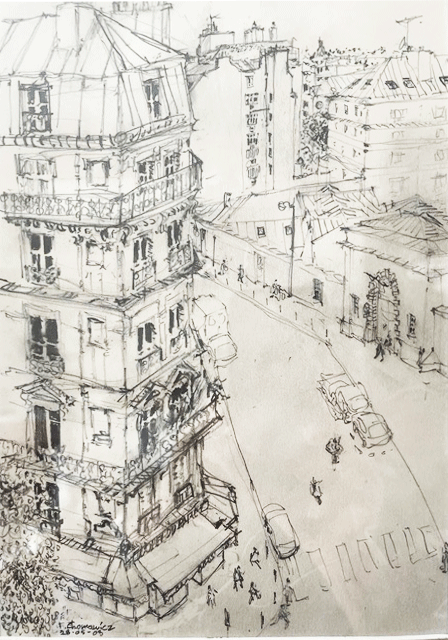
And work he did. It didn’t take long for Fred to be consumed by the school’s dynamic faculty. One of the most indelible impressions was left by his drawing teacher, Robert Gwathmey. Unlike artists such as Alberto Giacometti, whose searching line builds and accumulates form across the page, Gwathmey favored the surety of pen. A style where the first mark is also the last; a fast, fluid, calligraphic line that distills an object to its truth. This style gave Fred the lifelong ability to observe and record the wonder of the world around him. Whether the jagged peaks of Machu Picchu, the soggy streets of Paris in springtime, or the weariness and exhaustion of his fellow commuters, everything could best be understood with keen observation, paper, and pen.
Ironically, it was a scrappy, Lower East Side college that also gave Fred a life long appreciation for nature. Fred often recounted the adventures he had at Green Camp and the many clubs he belonged to including drama, hiking, and rifle, though he was fond of saying that he didn’t shoot a gun until basic training in the Army. One wonders what they actually did in that club!
Fred’s greatest love, one that lasted throughout his entire life, was also found at Cooper, but not in the classroom. In his very first week of class, he helped a first-year art student, Lucille Young, figure out how to use a ruling pen. That chance encounter led to a 71-year marriage—Fred and Lucille were a true Cooper Couple.
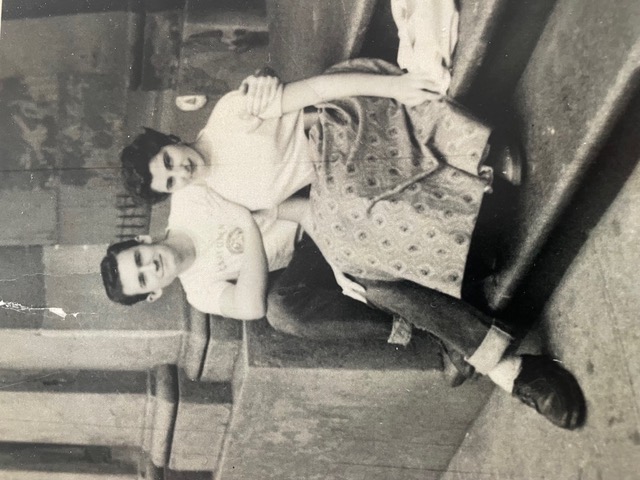
The 1950s were a heady time around Astor Place. Folk music was everywhere, Pete Seeger often performed to packed houses, the Great Hall hosted countless free lectures, readings, and recitals, and the Whitney Museum was just a gallery on 8th Street. And over at McSorley’s, their prohibition on serving female customers meant boyfriends would dress up their girlfriends to look like men just so they could glimpse its storied, if stale smelling, interior. Without hesitation Fred would proclaim the gift of a Cooper education. It gave him a career, a wife, an artistic life. He would often say how its uniqueness made everything else possible for him.
After graduating in 1953, Fred attended the University of Cincinnati School of Architecture on a full scholarship, followed by two years of service in the US Army at Fort Belvoir, Virginia, where no doubt his time in the Cooper Rifle Club came in handy!
Fred and his family returned to New York, where he built much of his career at Davis, Brody, Bond Architects. Specializing in laboratory and medical buildings, he founded and led the firm's Philadelphia office for many years. In the late 1980s, he began teaching at The Cooper Union, ultimately spending more than two decades here. His course on professional practice was one that, by his own admission, most students didn’t pay much attention to while absorbed in their thesis work, but it was the one he heard about most often afterward. Alumni reached out to him for years, grateful for the practical foundation his course had given their careers. Upon retirement, Fred and Lucille moved to Portland, Oregon, where for more than ten years he supported Zimmer, Gunsul, Frasca Architects on projects throughout the US and abroad.
Fred also discovered a passion for stage acting at The Cooper Union and never let it go. Throughout his career, he joined the casts of dozens of community productions across New Jersey, delighting in offbeat characters, especially those that called for a mastery of foreign accents. He was a lifelong traveler who explored Asia and South America, though it was to Europe that he returned most often. He never tired of Paris or Venice, his two most beloved cities.
Throughout his life, Fred was a draftsman. He drew everything: cities, buildings, the textures of daily life, and most especially people. His thousands of drawings of fellow commuters stand as a remarkable portfolio of a life spent in careful observation of humanity. This was Fred’s singular gift as an artist: he held up a mirror to the world so that the rest of us might better understand it—and ourselves. In his characters, his drawings, his buildings, and his teaching, Fred offered a quiet conviction that each of us has something to contribute to a deeper understanding of what it means to be human.
Fred is survived by his wife Lucille A’54, his daughter Amy, his sons David and Peter AR’89, and four grandchildren.